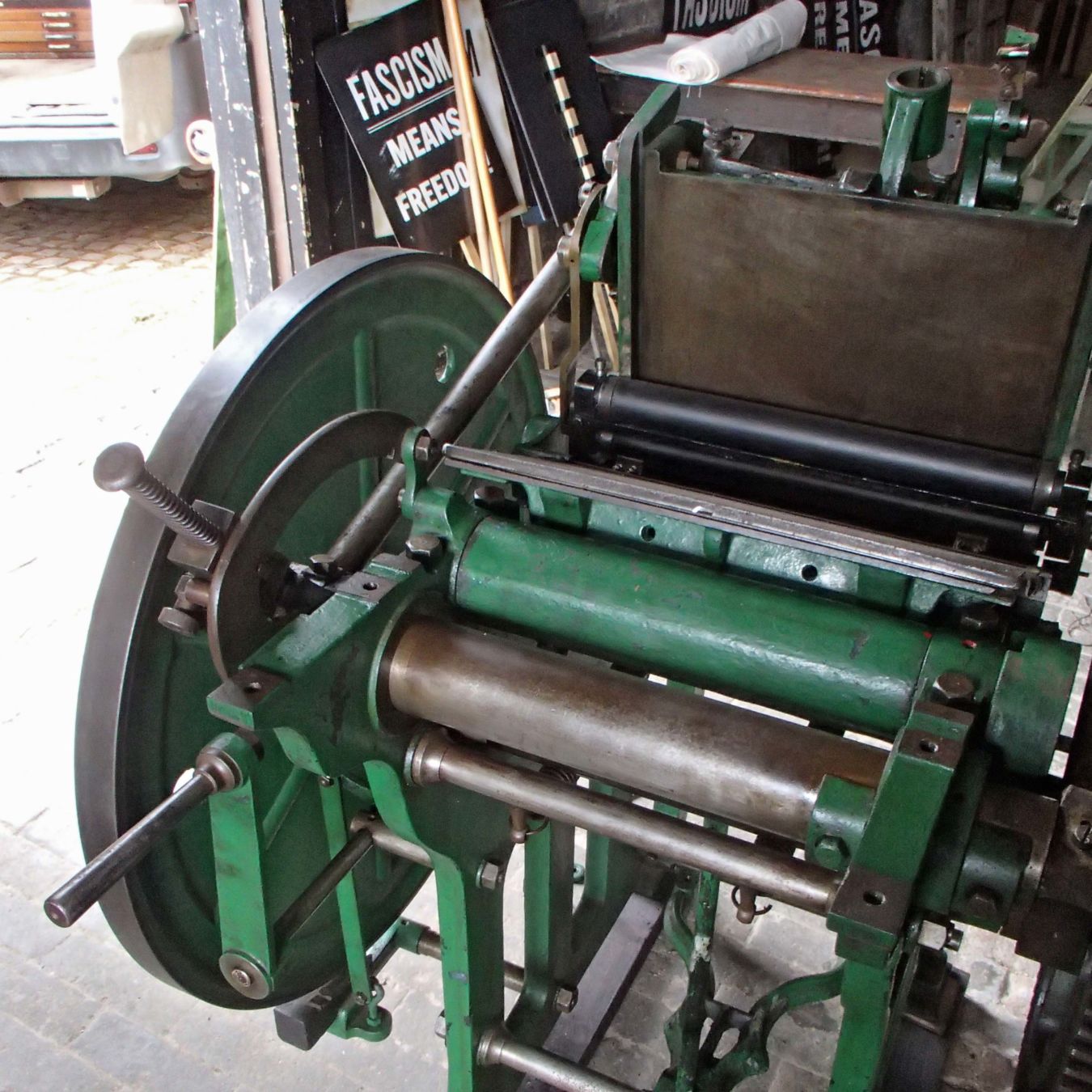
On Monday 1st July 2024, Patrick Roe and Guy Brudenell of AMR Logan Press delivered an Arab letterpress machine to a film location in Luton. The press was to appear in Outrageous, the television drama based on the Mitford sisters and their political entanglements during the 1930s.
The machine itself had been chosen with care. This was no generic “old printing press” brought in as a theatrical prop, but exactly the kind of working press that might genuinely have been used to print political pamphlets, newsletters and propaganda during the interwar years.
The Arab press had originally been designed and manufactured in Halifax by Josiah Wade (1842–1908), whose firm became one of Britain’s best-known makers of platen presses. Wade’s Arab presses were built in large numbers from the late nineteenth century onwards and became a familiar sight in jobbing print shops throughout Britain and the Empire. Rugged, relatively compact and mechanically straightforward, they were the dependable workhorses of small commercial printing.
By the 1930s presses like this were everywhere: printers’ basements, railway arches, chapel print rooms and political headquarters. Examples travelled widely, and some even reached unusually distant or specialised settings, including missionary work in the Congo. At least one is also believed to have had brief use aboard the Titanic.
In the context of Outrageous, the press was intended specifically to represent machinery used within the headquarters of the British Union of Fascists, where such equipment would have been employed to produce pamphlets, circulars and internal propaganda material. That detail makes the choice of press particularly appropriate, as it reflects the kind of practical, workaday printing equipment actually used by political organisations of the period.
The example supplied by AMR Logan Press dated from the 1920s, and one feature in particular reveals its age to those familiar with historic machinery. Earlier Arab presses were fitted with elegant curved-spoked flywheels; this example instead has a solid cast flywheel.
That detail reflects an important stage in the evolution of industrial casting.
Nineteenth-century flywheels were commonly cast with curved spokes, partly because early iron casting was prone to internal stress as metal cooled. As iron solidified, uneven contraction across a large casting could lead to cracking, a defect known in foundry practice as “hot tearing.” Curved spokes helped accommodate that stress, giving the wheel a degree of flexibility while retaining structural strength. The design was therefore not simply decorative, but a practical response to the limitations of early casting techniques.
By the early twentieth century, advances in foundry control, metallurgical consistency and cooling processes significantly reduced these risks. More predictable iron composition and improved control over solidification allowed manufacturers to cast solid disc flywheels reliably. As a result, designs became heavier, simpler and more economical to produce, while also reducing the number of exposed moving parts.
The transition is visible in presses like this Arab. Earlier examples retain the lighter, curved-spoke wheels of Victorian engineering, while later machines increasingly adopt solid flywheels—robust, efficient, and less likely to catch a hand or sleeve in motion.
For the television production, the press therefore carried exactly the right historical presence. It is a genuine survivor from the period being portrayed—a machine contemporary with the political extremism, social upheaval and propaganda struggles of the 1930s.
Of course, transporting such machinery to a film set is a very different matter from handling ordinary props. Even comparatively compact treadle presses like this half-ton Arab contain heavy, finely balanced components that demand careful handling and experienced judgement rather than brute lifting power.
For AMR Logan Press, however, this is familiar work. The company continues a specialist tradition of press moving, installation and preservation long associated with figures such as Chris Holladay, Patrick Roe and Giles Hovendon. While audiences may only glimpse the Arab press briefly on screen, the machine itself represents nearly a century of industrial history—and the continuing craft required to keep such machinery operational.
In the end, there is something fitting about an old Arab press returning, however briefly, to the world of political drama. These machines were never merely objects of industry. They were the means by which ideas—whether persuasive, ideological, or dangerous—were set into ink on paper and made public, one impression at a time.
Marketplace – Buy and Sell Today!
Access a dedicated marketplace for printmaking equipment. Trusted by artists, studios, and workshops across the UK.
