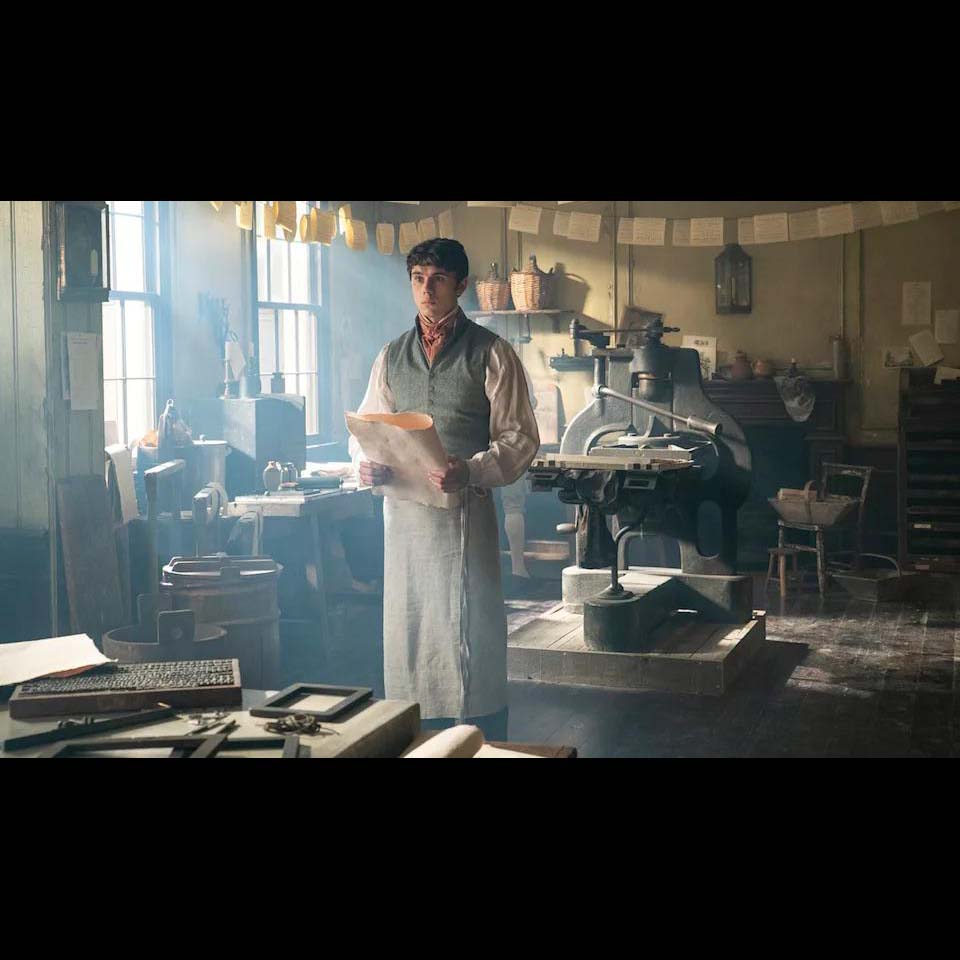
In 2021 we were asked to transport a Stanhope printing press from the University of Reading to film studios at Uxbridge, where it was to appear as part of the set for the Netflix series Bridgerton. The press was required as authentic background dressing for the print shop where Lady Whistledown’s society papers were supposedly produced.
Although it appears only briefly on screen, the Stanhope was exactly the right machine for the setting. Invented around 1800 by Charles Stanhope, Third Earl Stanhope (1753–1816), it was the world’s first successful all-iron printing press and one of the most significant advances in printing technology since Gutenberg’s invention of movable type and the wooden common press.
Earl Stanhope was an extraordinary man. A distinguished statesman, scientist and inventor, he devoted much of his life to applying practical engineering to everyday problems. His interests ranged from mathematics, navigation and steam power to fireproof buildings, canal locks, calculating machines and printing. Elected a Fellow of the Royal Society while still a young man, he became known as much for his restless curiosity as for his political career. He believed that machinery could be improved by careful thought and sound engineering rather than simply by following tradition.
Rather than manufacturing the presses himself, Stanhope licensed his design to a number of British makers, the best known of whom was Robert Wood of London. Many thousands were also produced in France, where the design remained popular throughout the nineteenth century. Today, however, English-built Stanhopes are generally more highly prized, with presses by Robert Wood particularly sought after for their quality, historical significance and comparatively small numbers.
Transporting a Stanhope is rather more demanding than its graceful appearance might suggest. Much of its weight is concentrated in the top half of the press and at one end. Careful handling is therefore essential throughout loading, transport and installation, particularly when working within the confined spaces of a busy film studio.
Viewers may not take particular notice of the press in the background, yet its presence contributes greatly to the authenticity of the scene. Historic machinery often plays a quiet but important rôle in film and television, helping to create a convincing world while attracting little attention to itself. For a few days, one of Britain’s historic Stanhope presses exchanged the peace of a storage building in Reading for the bustle of a television studio. Its latest journey has been rather more important, as we recently moved it once again—this time into its new home in the Department of Typography & Graphic Communication, where it can continue to be studied, demonstrated, used and appreciated by future generations.
