It is not often that a press returns to you after forty years.
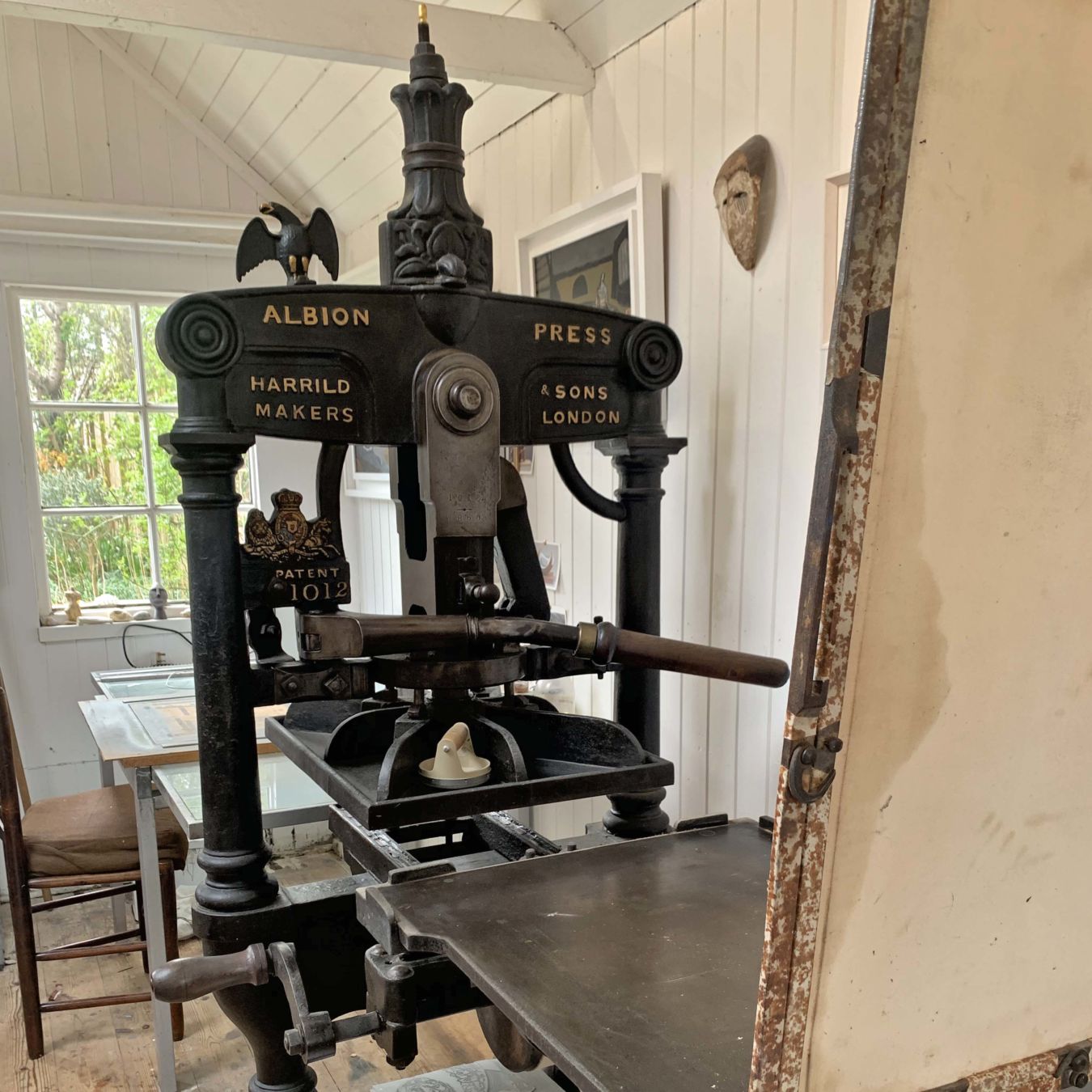
Recently, AMR Logan Press added a Marketplace section to their website — a place where printmakers can offer presses for sale, often with little more than a few photographs and a brief description. Among the current listings is a Harrild Albion press, with an eagle on top and a particularly interesting past.
The press had been sourced by Giles Hovendon thirteen years ago from a print group in Aldeburgh and moved to Sevenoaks. Installation was not straightforward — it had to be taken around the side with a steep slope due to recent building works — but it eventually found its place in a picturesque studio.
So far, a familiar enough story.
But this one remembered more than most.
It turns out that I had moved this very same press myself some forty-one years earlier, in 1985.
At that time, it belonged to Maty Grunberg — an Israeli artist known for his limited edition books and his use of etching, silkscreen, and woodcut. The press was delivered to his studio at 5c Pond Street in Hampstead.
I made the journey from Gloucestershire in a 1972 ex-electricity board long-wheelbase Land Rover Series III.
I remember the day vividly. It was late August 1985, and exceptionally hot.
On arrival, Maty took one look at my big nose and asked my family name. “Roe” did not meet with much interest, although my grandmother’s maiden name of “Hayman” seemed, incorrectly, to confirm his suspicions.
As I brought the press in, assembled it, and installed it, we spent several hours listening to the radio.
Across the river at The Oval, England were playing Australia.
That day would become notable for a remarkable second-wicket partnership between Graham Gooch and David Gower — 351 runs. England went on to make 464, ultimately defeating Australia by an innings and 94 runs.
It is a small detail, perhaps. But these are the things that fix a moment in time.
A press being installed. A hot summer’s day. A cricket match playing out in the background.
After Giles had moved the press, it underwent a quieter transformation.
What had been a rather drab green-grey exterior was carefully cleaned back, revealing a far more fitting black finish beneath. The present owner went further, picking out the coat of arms in gold and red — restoring a sense of identity and presence to the machine.
During this process, another discovery emerged.
Fixed to the base was a copper-coloured printing plate. Once removed, inked, and run through the press, it offered a direct connection to the press’s working past — an impression carried forward through time.
The Albion press, first developed in the early 19th century, remains one of the most enduring and capable forms of handpress. Machines like this were built not just to last, but to continue — to pass from one printmaker to another, accumulating stories along the way.
This particular Harrild Albion has done exactly that.
From a London studio in the 1980s, to Suffolk, to Kent, and now appearing once again on a marketplace listing.
There is something rare in encountering an object like this twice across a working lifetime.
To move a press is one thing. To recognise it decades later, and to be able to trace its path through people, places, and moments — that is something else entirely.
The press itself has not changed in any fundamental way. But its story has grown.
And it is not finished yet.
Written by Patrick Roe — if you would like to find out more about this or any other article, please email: info@printmaking.world
Marketplace – Buy and Sell Today!
Access a dedicated marketplace for printmaking equipment. Trusted by artists, studios, and workshops across the UK.
