In the history of British printmaking there are certain figures whose influence far outweighs the number of times their names appear in print. Chris Holladay was one of them.
To many printmakers, technicians and studio founders from the 1970s onwards, Holladay was simply the man you called when a press needed moving, rebuilding, installing or rescuing. He occupied a unique corner of the printmaking world where engineering met practical ingenuity, and where an intimate knowledge of Victorian ironwork was every bit as important as brute strength.
Chris Holladay was associated with Modbury Engineering which became known within printmaking circles for producing etching presses with a flexible bed for larger printing areas while occupying less floor space. This innovative design resulted in solid, dependable machines ideal for serious studio use, and many remain in operation today.
Yet Holladay’s reputation ultimately rested on something even more specialised: the moving and installation of historic printmaking presses.
That may sound straightforward until one stands beside a Kimber, Rochat or Columbian press. These were not simply pieces of workshop equipment but monumental cast-iron machines weighing up to a tonne or more, often installed in awkward buildings long before modern access regulations or lifting equipment were imagined. Moving them required engineering judgement, patience and nerve. Entire presses frequently had to be dismantled piece by piece, transported through narrow staircases or courtyards, and then reassembled with absolute precision.
Over time, Holladay became the quiet custodian of this disappearing knowledge.
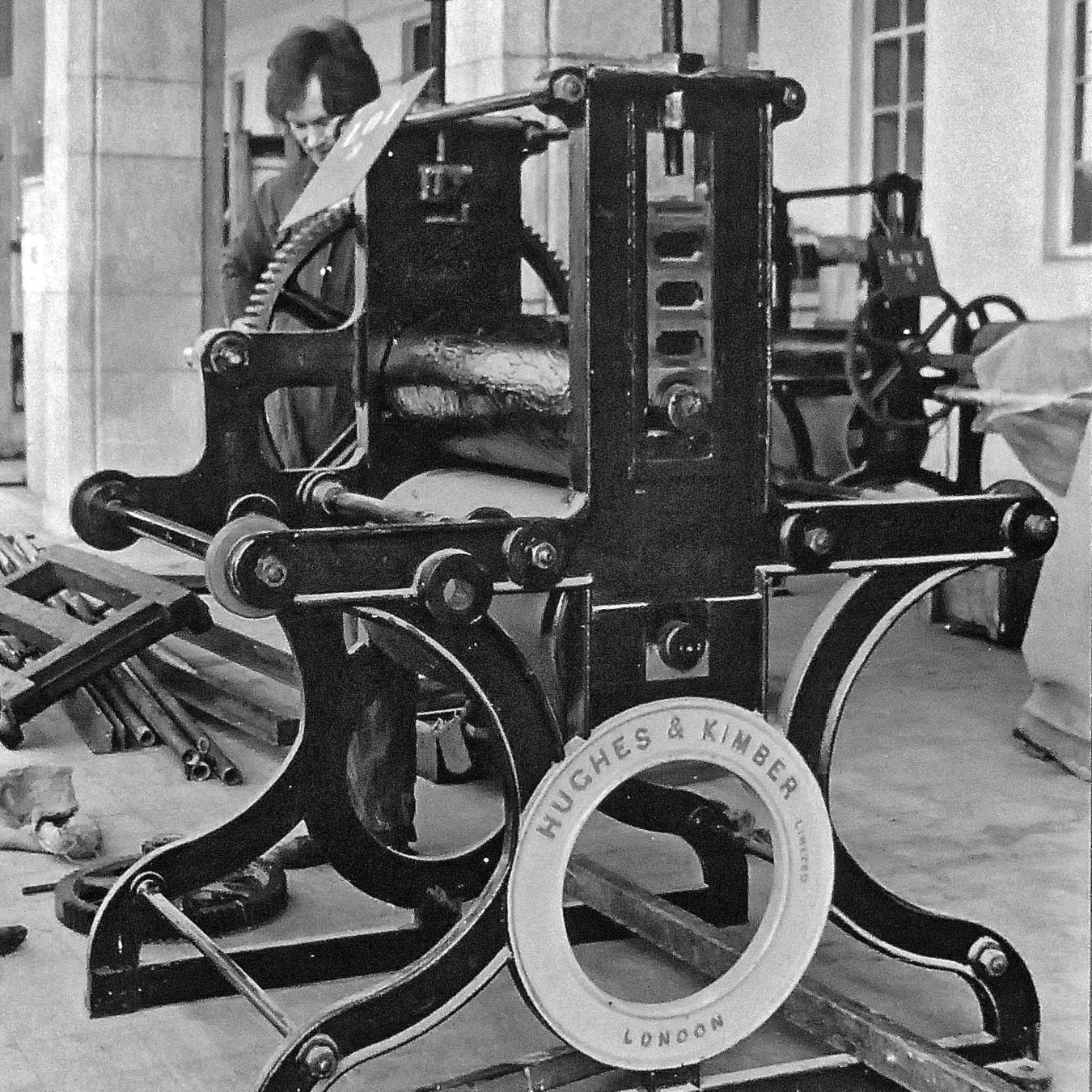
His name became familiar in studios, art schools and print departments across Britain. If a Hughes & Kimber had to be removed from a college basement, if an Albion press needed relocating to a new workshop, or if a Victorian etching press required rebuilding after decades of neglect, Chris Holladay was usually the person entrusted with the task.
The surviving photographs of him at work capture something of that world. In the one shown he stands beside a great Hughes & Kimber press during a move from a large institution to an artist’s home studio. The photograph reveals not only the scale of the machinery but also the practical choreography involved in handling it safely. Nothing about the process was casual.
There is also something strikingly characteristic about the atmosphere of the images themselves: no high-visibility jackets, no forklift trucks, no corporate branding — just an engineer, iron, timber skids, chains and experience. Much of Britain’s printmaking infrastructure survived because people like Holladay understood how to work with machinery that most modern removals firms would refuse to touch.
His expertise extended beyond transport alone. Holladay understood presses as working mechanical systems. Rollers needed levelling correctly. Bearings had to run true. Frames twisted over decades needed coaxing back into alignment. The difference between a press merely installed and a press printing beautifully often lay in such details.
A small but revealing reference survives in the history of Artichoke Print Workshop in Brixton, which records that the studio was established in the early 1990s “with the help of engineer Chris Holladay.” It is a brief acknowledgement, but an important one. Across Britain there are dozens of workshops whose presses arrived, survived or continued working thanks to his knowledge.
When Holladay eventually retired, much of that specialist work passed naturally to Giles Hovendon, who continued serving many of Chris Holladay’s long-established customers through Antique Machinery Removals (AMR). At the same time Patrick Roe of The Logan Press had already been moving presses — particularly letterpress machinery — since the late 1970s, developing extensive experience in the handling, dismantling and transport of heavy printing equipment. Roe and Hovendon worked closely together, their skills and experience complementing one another across both printmaking and letterpress machinery.
In 2020 the two companies formally merged to become AMR Logan Press, continuing the tradition of specialist press moving and installation established by Holladay decades earlier. Today the company handles the daily movement, installation and preservation of historic presses throughout Britain, ensuring that these remarkable machines continue working for studios, printmakers and collectors alike.
Many younger printmakers may never have heard Chris Holladay’s name, even while working daily on presses he installed, repaired or moved. Yet his contribution forms part of the hidden engineering backbone of British printmaking culture.
Studios may celebrate artists, printers and publishers, but behind many successful workshops stood figures like Holladay: practical engineers whose skill ensured that the great presses of the nineteenth and twentieth centuries remained alive, operational and capable of making new work for another generation.
Marketplace – Buy and Sell Today!
Access a dedicated marketplace for printmaking equipment. Trusted by artists, studios, and workshops across the UK.
