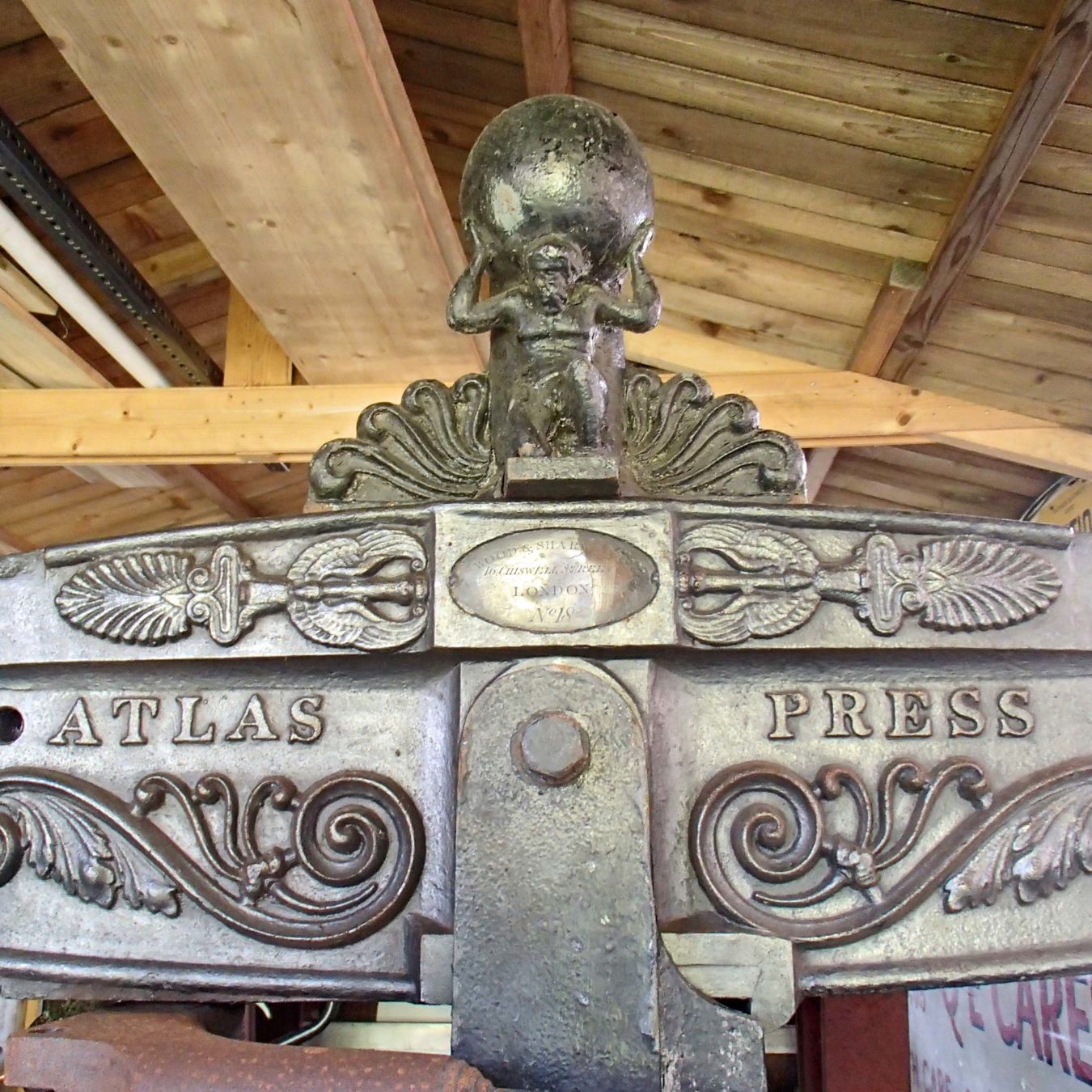
Some presses arrive complete, quietly waiting to be understood.
Others arrive as questions.
This Atlas press began as the latter — discovered in a garden, exposed to the elements, and missing its most critical components: the impression mechanism. What remained was substantial, undeniably historic, but incomplete in a way that rendered it inoperable.
And yet, even in that state, it was clear this was no ordinary press.
Made by Wood and Sharwood of 16 Chiswell Street, London, this example is numbered 18. Based on that address and the known history of the firm, it is likely that the press dates from around 1833 — placing it among the earlier surviving iron handpresses of its kind.
The Atlas belongs to that remarkable period in printing history that followed the introduction of the iron press, when makers were still actively exploring form, mechanism, and identity. Where the Albion press refined efficiency and simplicity, the Atlas carries something more expressive.
Its defining feature is unmistakable: the main spring housed within a casting depicting Atlas himself, bearing the weight of the world. It is both structural and symbolic — engineering and ornament combined in a way that feels entirely of its time.
The absence of the impression mechanism presented a fundamental problem.
Without it, the press cannot function — and unlike more common machines, there is no ready supply of replacement parts, no catalogue to consult, no standard pattern to follow. Each component had to be understood, then recreated.
This is where restoration becomes something else entirely: not repair, but reconstruction.
To move forward, we needed a reference.
Time was spent at the University of Reading, where a complete Atlas press survives with its impression mechanism modified but intact. Over the course of a day, that mechanism was carefully dismantled, documented, and studied in detail.
Measurements were taken. Drawings made. Photographs recorded from every angle.
Piece by piece, the logic of the mechanism revealed itself.
Back in the workshop, that information became the foundation for a new set of components.
Patterns were produced first — not as finished parts, but as a way of testing the theory. Would the geometry translate? Would the clearances work? Would the press take an impression not just in principle, but in practice?
So far, so good.
From there, the process has moved into manufacture. Using Siemens NX, detailed drawings and machining files have been created, allowing components to be produced with a level of precision that the original makers could only have approached by skill and experience alone.
It is, in a sense, a collaboration across centuries.
This is not a quick restoration.
The owner — patient by necessity as much as temperament — is simultaneously restoring a building in Blackpool that will house the press once complete. The two projects are running in parallel, each shaping the timeline of the other.
If all goes to plan, the Atlas will return to working life at the same moment its new home is ready to receive it.
There is something particularly satisfying about work like this.
Not simply preserving what remains, but rebuilding what has been lost. Taking a press that had effectively fallen silent and giving it the means to speak again — not as a replica, but as a continuation of its original purpose.
The Atlas was never meant to sit idle.
And soon, it won’t.
Written by Patrick Roe — if you would like to find out more about this or any other article, please email: info@printmaking.world
Marketplace – Buy and Sell Today!
Access a dedicated marketplace for printmaking equipment. Trusted by artists, studios, and workshops across the UK.
