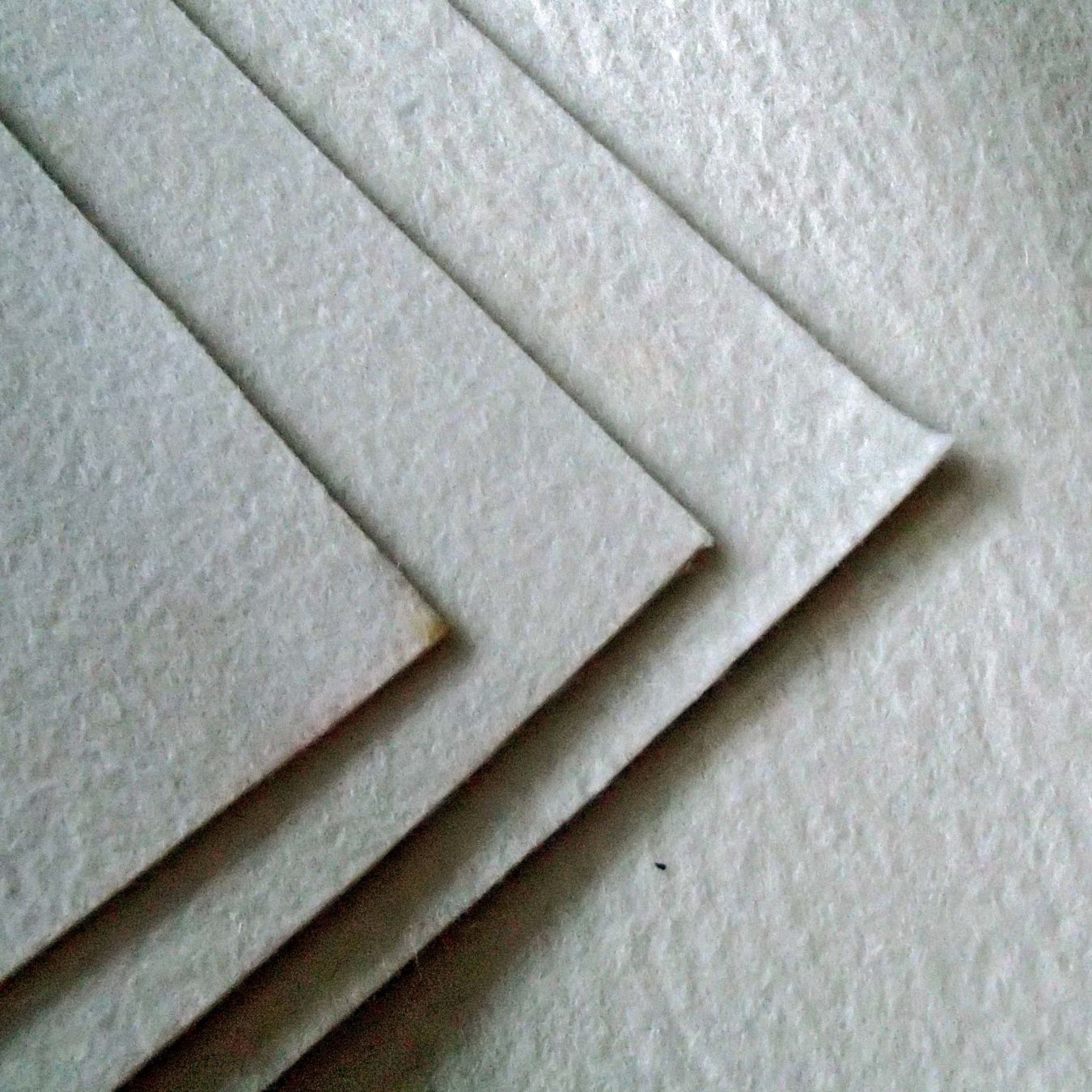
Among the various parts of an etching press, few are more important, or more often taken for granted, than the blankets. They sit in place doing their work day after day, and it is usually only when they begin to stiffen, mark, or behave less evenly that they receive much attention. The condition of the blankets has a direct influence on the quality of every print, and with a little understanding and care, a good set should last for many years.
Most presses use three blankets, although not all printmakers work in quite the same way. Some use only two. The full arrangement consists of a swanskin (which is often known as a fronting felt), a cushion or compressed wool backing, and a top blanket, sometimes referred to as the pusher. The swanskin lies nearest the paper, the cushion sits on top of it, and the top blanket lies on top of the others, next to the impression roller.
It is easy to think of an etching blanket as little more than a piece of felt, but wool has qualities that make it remarkably well suited to the job. Each fibre is naturally crimped, allowing the material to compress under the considerable pressure of the press and then recover its form once the pressure is released. It also deals with moisture in a rather forgiving way, which matters more than is sometimes appreciated when working with dampened printmaking papers. Taken together, these qualities allow the blankets to distribute pressure evenly while encouraging the paper into the finest engraved or etched detail of the plate.
The swanskin inevitably does the hardest work. As the dampened paper passes through the press, some of its sizing is absorbed into the fibres of the blanket. Many traditional mould-made printmaking papers are still made using sizing materials that include modified potato starch, although the formulations have evolved over the years. Whatever the source, the effect is much the same. Over time, the accumulated sizing can make the blanket take on a slightly starched feel.
Fortunately, this is one of the few aspects of printmaking that can often be improved with fairly simple treatment. A gentle hand wash in lukewarm water with a mild wool wash such as the good old-fashioned Lux Flakes or the more recent Woolite has always served printmakers well. Strong detergents, bleach, fabric conditioners and vigorous scrubbing should be avoided as they may damage the fibres. Washing away the accumulated sizing allows the wool fibres to recover much of their original suppleness.
Once washed, the blanket should not be wrung or twisted. Wool felt is at its most vulnerable when saturated, and distortion at this stage can become permanent. It is better to allow the water to drain naturally before passing the damp blanket through the press a couple of times without a plate. This removes much of the remaining moisture without disturbing the structure of the felt. The blanket should then be dried flat between towels or sheets of blotting paper. Hanging it up may seem convenient, but the weight of retained water can easily stretch the felt out of shape.
Day-to-day handling is just as important as the occasional wash. Blankets should never be folded, as a sharp crease compresses the fibres and can leave a lasting mark. Flat storage is best where possible, though rolling them loosely around a large tube is the next best thing when space is limited. It is also a good idea to release the pressure on the press when not in use. Leaving the roller tightened down for long periods serves no useful purpose and will flatten the wool.
Blankets do not last for ever, but neither should they be thought of as disposable. The swanskin usually shows wear first, simply because it does the most demanding work, though in many cases it is not worn out so much as gradually clogged with sizing. A good wash will often restore much of its former responsiveness. Only when the felt has become permanently compressed, badly worn, creased or torn does replacement become necessary, and many printmakers keep a spare swanskin for that reason.
Good blankets rarely attract attention, which is perhaps the best indication that they are doing their job properly. A little care, sensible handling and an occasional wash are usually all that is required to keep them in good order, and they reward that attention many times over in the consistency and quality of the prints they help to produce.
New etching press blankets are available from Intaglio Printmaker.
