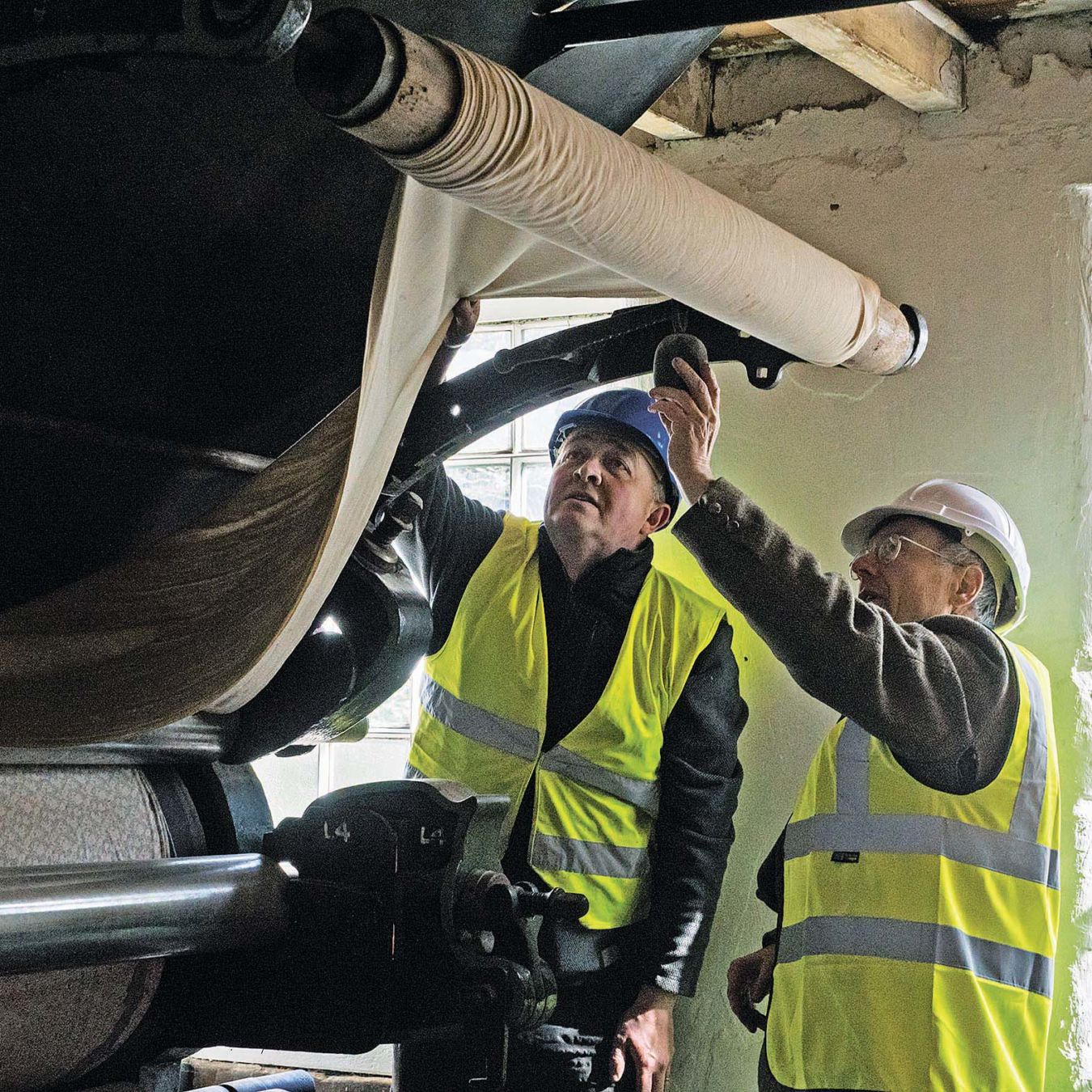
In March 2018, a small team came together for a very particular task.
Sarah Cutler, Patrick Roe, Guy Brudenell and Ben Hamilton of The Logan Press joined forces with Giles Hovendon of AMR Press to dismantle and remove a large and historically significant printing machine from Quarry Bank Mill.
Its destination was a storage facility for the Science Museum.
The press itself was unlike the printmaking presses more commonly encountered.
It was a five-colour fabric printing machine, working on a principle similar to gravure printing. Each colour was carried on its own engraved and chromed plate cylinder, inked with fabric dye and transferred in sequence onto cloth against a common impression cylinder.
Built on an industrial scale, the machine measured around twenty feet in length, ten feet in width, and rose almost to the ceiling. In total, it weighed in the region of three tonnes.
The machine was number 39, manufactured by William and Colin Mather sometime between 1824 and 1852.
This places it firmly within a period of rapid technological development in textile and printing machinery, when innovation was constant and obsolescence came quickly. Machines were improved, replaced, and often scrapped without much thought for their long-term survival.
For that reason, it is highly unlikely that another example of this type still exists.
The removal of such a machine is never routine.
To make it manageable, the press had to be dismantled completely into three principal components: the impression cylinder and the two side frames. Even in these reduced forms, the scale and weight of each section remained considerable.
The route out of the building added another layer of complexity.
The machine was located on an upper floor of the mill, and each component had to be carefully manoeuvred through the structure and out onto scaffolding that had been erected specifically for the task.
In practice, this proved to be one of the more delicate aspects of the entire operation.
Within an institutional setting, responsibility is rarely taken lightly. The scaffolding, although in place, became the focus of understandable concern. No single party was willing to assume responsibility without further assurance.
Work paused.
It was several months before a surveyor was brought in to assess the structure and specify additional strengthening. Only then could the process continue.
It was a reminder that, alongside engineering and logistics, projects like this must also navigate process and accountability.
Alongside the physical work, a detailed account was produced.
A sixteen-page report, supported by hundreds of photographs, documented the process from beginning to end. Every stage of dismantling, every significant component, every structural detail was captured as part of a permanent record.
In many ways, this documentation is as important as the machine itself.
Once removed from its original setting, context can easily be lost. The report ensures that the knowledge of how the press was constructed, assembled, and handled remains accessible for the future.
Projects like this sit somewhere between engineering, conservation, and history.
The machine at Quarry Bank Mill was not simply an object to be moved, but a rare survivor from a period of intense industrial change. Its preservation — both physical and recorded — ensures that it can continue to inform and be understood.
Not just as a piece of machinery, but as part of a much larger story.
Written for Printmaking World, 2018 — if you would like to find out more about this or any other article, please email: info@printmaking.world
Marketplace – Buy and Sell Today!
Access a dedicated marketplace for printmaking equipment. Trusted by artists, studios, and workshops across the UK.
