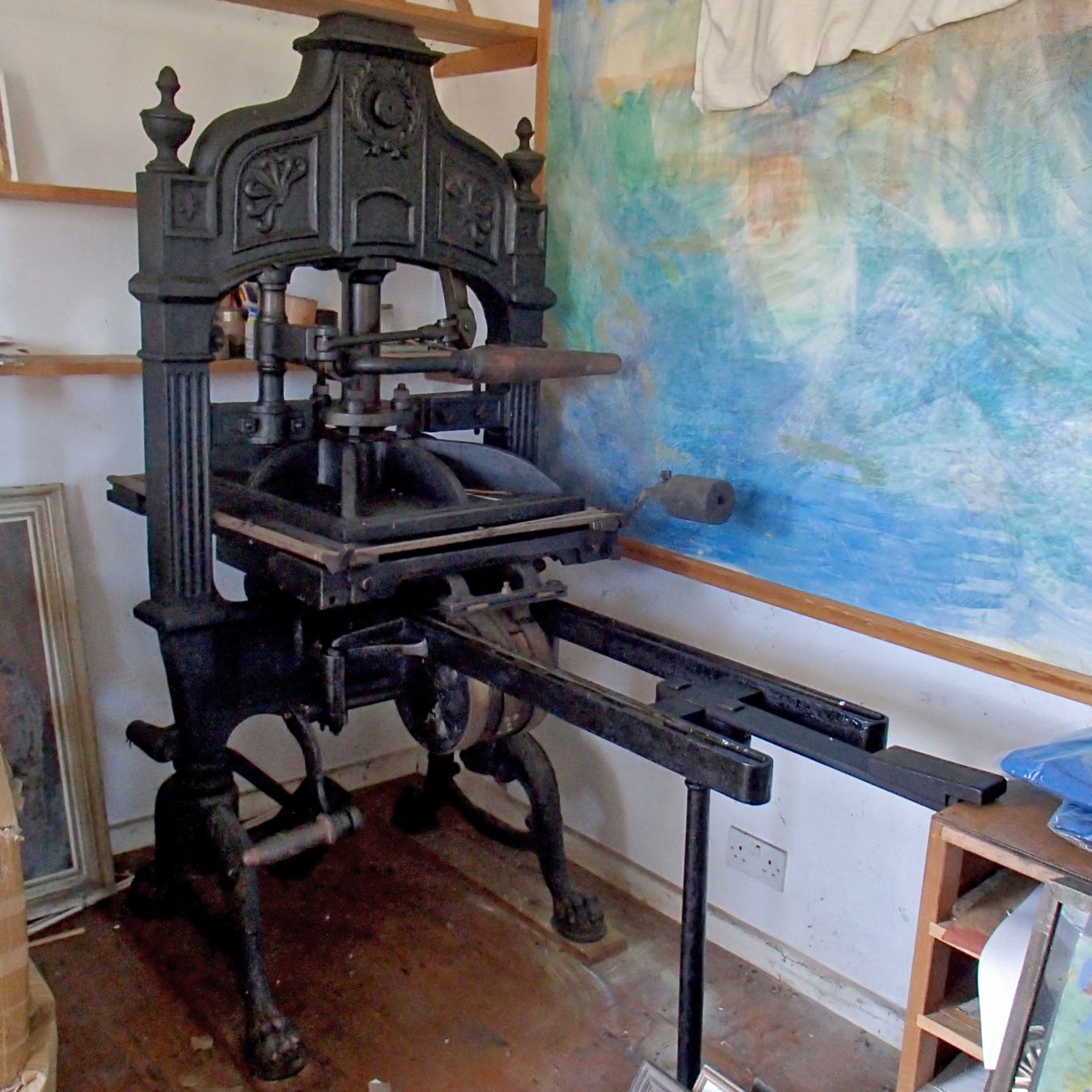
On Tuesday 31st March 2026 I drove to Kidlington, just north of Oxford, to carry out a valuation.
The request was a familiar one. A house inherited, a studio tucked away in the garden, and inside it — something substantial, clearly important, but entirely unknown to its new owners. They needed a valuation for probate, and more fundamentally, an answer to a simple question: what is it?
When I arrived and the studio doors opened, the answer was immediately clear.
It was a Britannia.
Not just any press, but a particularly fine example of the Britannia iron handpress — one of the later developments in hand-operated letterpress printing machines, and a distinctly English expression of engineering in print.
The Britannia press belongs to the long lineage that follows the great leap made by Earl Stanhope in the early 19th century. His all-iron press transformed printing from timber-framed machines into something far more rigid, powerful, and precise.
By the mid-to-late 1800s, presses like the Britannia and the much more common Albion represented a mature form of that evolution.
They are immediately recognisable:
The Britannia was built for reliability and consistency, capable of fine letterpress work while enduring decades of use. Compared to earlier presses, it offered improved mechanical advantage and a smoother pull, making it both efficient and satisfying to operate.
Today, surviving examples are relatively scarce, particularly in complete and well-preserved condition.
This particular press had presence.
It sat exactly where it had likely worked for decades, within a studio that had clearly once been active. There’s a certain stillness to these spaces when they’ve been left behind: tools in place, equipment at rest, the sense that work has paused rather than ended.
The press itself was beautifully made. English engineering at its best — solid, balanced, and built with an understanding of both force and finesse. Even before any detailed inspection, it was obvious that this was not a commonplace machine.
For the owners, it was a revelation. What had been an unknown, slightly daunting object in the corner of a garden studio was, in fact, a rare and historically significant printing press.
Valuing a press like this is never just about assigning a number.
Condition, completeness, originality, and provenance all play their part. But so too does something less tangible: desirability. The Britannia sits in an interesting position — less widely known than some presses, but highly regarded by those who understand them.
That combination often makes for a strong and sometimes surprising valuation.
In cases like this, experience matters. Understanding not just what a press is, but how it fits into the wider landscape of printmaking history and current demand, is essential.
Encounters like this are one of the more rewarding parts of the work.
A press, long out of use, re-identified. Its story picked up again. Its value — both historical and practical — recognised once more.
The Britannia in Kidlington is no longer an unknown quantity. It is, once again, part of the ongoing story of printmaking.
This particular press is now for sale on the AMR Logan Press marketplace: https://amrloganpress.co.uk/marketplace/britannia-iron-handpress/
Written by Patrick Roe — for further details on this or any other article, please email: info@printmaking.world
Marketplace – Buy and Sell Today!
Access a dedicated marketplace for printmaking equipment. Trusted by artists, studios, and workshops across the UK.
